TOP 1. DC Power Supply Variable
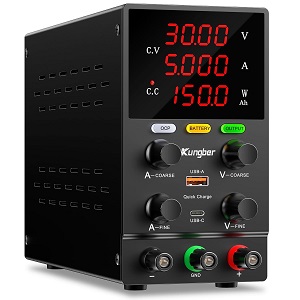
The DC Power Supply Variable 30V 10A Adjustable Switching Regulated Bench Power Supply is a high-quality, reliable tool designed for precision power delivery. With an output range of 0-30V and 0-10A, this power supply offers flexible voltage and current adjustments for a variety of applications, from electronics testing to lab experiments. Featuring an intelligent charging mode, it provides efficient and safe charging for devices such as batteries and mobile electronics. The 18W USB interface allows for convenient charging or powering of USB devices. Equipped with a precision encoder knob, it offers smooth and accurate control over voltage and current settings. Compact and durable, this power supply is ideal for professionals, hobbyists, and technicians seeking reliable and adjustable power in their work.
Specifications:
- Output: 0-30V, 0-10A
- Features: Intelligent charging mode, 18W USB port, precision encoder knob
- Design: Compact and durable, with easy-to-adjust voltage and current
Pros:
- Wide voltage and current range, suitable for various applications
- Includes a USB interface for convenient device charging
- High precision control with encoder knob
- Ideal for professional labs and hobbyist use
Cons:
- Larger and potentially heavier than mini models
- May be over-featured for simple tasks
TOP 2. NICE-POWER DC Power Supply
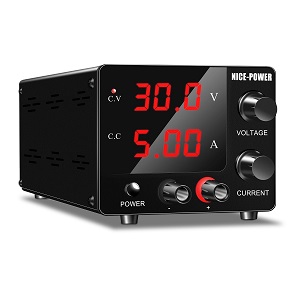
The NICE-POWER DC Power Supply Variable is a compact and reliable 30V 5A adjustable switching regulated power supply, designed for precision and efficiency in various applications. With its upgraded 3-digit LED display, it offers clear and accurate voltage and current readings, making it easy to monitor your settings. The encoder provides smooth, precise control for adjusting both voltage and current, allowing for fine-tuned adjustments. This mini regulated DC bench power supply is perfect for testing, repairs, and powering electronic projects, from hobbyist to professional use. Its compact size ensures easy portability without sacrificing performance, providing a versatile and user-friendly power solution for any workspace.
Specifications:
- Output: 0-30V, 0-5A
- Features: 3-digit LED display, precision encoder knob, compact design
Pros:
- Compact and portable, suitable for small workspaces
- Provides smooth control over power adjustments
Cons:
- Limited to 5A output, which may not be enough for high-power tasks
- Basic features; lacks USB or advanced safety functions
TOP 3. DC Power Supply
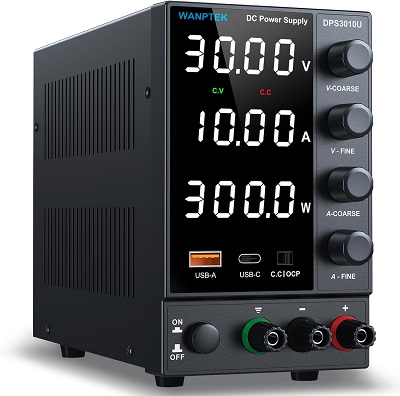
The DC Power Supply is a versatile and reliable bench power supply designed for precision and efficiency. With adjustable output ranging from 0-30V and 0-10A, it offers customizable voltage and current settings to meet various power needs for testing, repairs, and electronic projects. Featuring an encoder knob, it allows for smooth and accurate adjustments, ensuring precise control over your power supply. Additionally, it comes with a 5V 3.6A USB and Type-C quick-charge interface, ideal for charging devices or powering USB-enabled electronics. Built-in overcurrent protection ensures safety during use, while the compact design makes it easy to integrate into any workspace. Perfect for both professionals and hobbyists, this power supply provides reliable, regulated power for a wide range of applications.
Specifications:
- Output: 0-30V, 0-10A
- Features: Encoder knob, 5V 3.6A USB and Type-C quick charge, overcurrent protection
Pros:
- Includes USB and Type-C ports for charging versatility
- Built-in overcurrent protection for safety
- Adaptable to both hobbyist and professional uses
Cons:
- Slightly larger design may take up more workspace
- Limited to basic display for voltage/current
TOP 4. DC Power Supply Variable
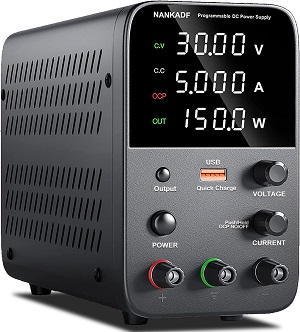
The DC Power Supply Variable is a high-performance bench power supply designed for precision and versatility in various electronic applications. With adjustable output ranging from 0-30V and 0-10A, it provides the flexibility to meet the needs of testing, repair, and project work. The encoder adjustment knob ensures smooth and accurate voltage and current control, while the output enable/disable button allows you to easily manage power flow. This model also features a USB quick-charge interface for convenient charging of devices, along with a short circuit alarm for added safety during operation. The sleek black design makes it a professional and reliable addition to any workspace, perfect for both hobbyists and professionals needing a stable, regulated power source.
- Specifications:
- Output: 0-30V, 0-10A
- Features: Encoder adjustment, output enable/disable button, USB quick-charge, short-circuit alarm
- Pros:
- Output control button adds convenience and safety
- Includes USB charging for external devices
- Short-circuit alarm enhances user safety
- Cons:
- More complex than basic models, which may be overkill for simple applications
- Potentially higher price due to additional safety features
TOP 5. Universal Compact Bench Power Supply
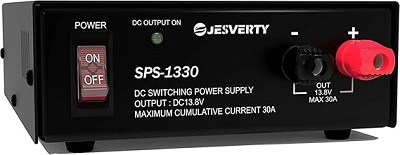
The Universal Compact Bench Power Supply (SPS-1330) is a powerful, 30-amp regulated AC-to-DC converter ideal for home labs and radio enthusiasts. With a fixed 13.8V output, this bench power supply is perfect for CB, HAM, and amateur radio applications, delivering reliable and stable power to your devices. Designed with screw-type terminals, it offers secure connections for various setups, while the built-in cooling fan ensures efficient heat dissipation for safe, continuous use. Compact and durable, the SPS-1330 is an excellent choice for those needing dependable DC power in a compact form, whether for professional or personal projects.
Specifications:
- Output: Fixed 13.8V, 30A
- Features: Screw-type terminals, cooling fan, compact design
Pros:
- High amperage output suitable for radio and CB applications
- Durable and compact, perfect for HAM or amateur radio use
- Effective heat dissipation using an integrated fan
Cons:
- Fixed output voltage (13.8V) limits versatility for other uses
- Primarily suited for specific applications like radio setups
DC Power Supply FAQ
1. What is a DC power supply?
A DC power supply provides a constant, stable DC (direct current) voltage to power various devices and components. It’s commonly used in labs, electronics testing, repair, and hobbyist projects.
2. What are the types of DC power supplies?
- Linear DC power supplies: Offer high stability and low noise but are typically larger and less efficient due to heat loss.
- Switching DC power supplies: Smaller, more efficient, and often used for higher power needs but can introduce electrical noise.
- Programmable DC power supplies: Can be controlled remotely or programmed for specific output values and sequences.
3. What should I consider when choosing a DC power supply?
- Voltage and current range: Choose a supply with output voltage and current that meets or exceeds your requirements.
- Power output: Ensure it provides enough wattage for your applications.
- Resolution and accuracy: Important for precise electronics work.
- Protection features: Overvoltage, overcurrent, and thermal protections add safety for sensitive devices.
- Programmability: Useful for automated testing or dynamic applications.
4. How do I connect a DC power supply safely?
- Ensure the power supply is turned off before connecting.
- Connect the positive output (often red) to the positive input of the device, and the negative output (often black) to the negative input.
- Double-check all connections to avoid shorts or incorrect polarities, which could damage the device or the power supply.
5. Can a DC power supply be used to charge batteries?
Yes, but it depends on the type of battery and the charging requirements. You must carefully control the voltage and current and follow the manufacturer’s specifications for safe charging. Consider using a power supply with a constant current (CC) mode for initial charging and a constant voltage (CV) mode for topping off.
6. What is CC (constant current) and CV (constant voltage) mode?
- Constant current (CC): Supplies a steady current by adjusting the voltage. Commonly used for initial stages of battery charging.
- Constant voltage (CV): Supplies a steady voltage, allowing current to decrease as the load requires. Useful for powering devices with a fixed voltage need.
7. What is the difference between voltage regulation and current regulation?
- Voltage regulation keeps the output voltage stable regardless of changes in load current.
- Current regulation maintains a constant current, adjusting the voltage as necessary. This is particularly useful in applications like LED driving or electroplating.